
Reviewed · HIKING & TREKKING
Mount Ijen Crater Trekking Tour from Bali
The main prize here is Ijen’s blue fire, a rare sight that appears in the dark when sulphur gases burn inside the crater. You leave Bali in the late afternoon, cross to Java by ferry, and begin the mountain walk well before sunrise, when the flames have the best chance of showing.
I like the honest sense of place: you meet sulphur miners carrying huge loads by bamboo baskets, and you see the crater before the day’s light washes out its strange colors. I also like that transport, a local trekking guide, breakfast, lunch, and a gas mask are included. The catch is simple: this is a long, tiring overnight trip with a hard climb, not a casual sightseeing outing.
In This Review
- Key points to know before booking
- Why Ijen’s blue fire is worth the hard night
- Leaving South Bali at about 5:00 pm
- Crossing to East Java after dark
- The 3 km climb to Ijen Crater
- Meeting sulphur miners on the mountain
- Seeing the blue fire before sunrise
- Breakfast above the crater, then daylight views
- Lunch, the return ferry, and the long way home
- Who should book this Ijen tour
- Should you book the Mount Ijen Crater Trekking Tour?
- FAQ
- What time does the Mount Ijen tour start?
- Which Bali areas have hotel pickup?
- How long is the Mount Ijen trek?
- Is the blue fire guaranteed?
- What equipment is provided?
- Is food included?
- Who should not take this tour?
Key points to know before booking
- The blue fire is weather dependent: You may see it before dawn, but no tour can guarantee clear conditions or an unobstructed view.
- The trek covers about 3 km: Expect one to two hours uphill over a mix of steep and flatter ground, followed by a descent.
- The Bali to Java transfer takes time: Pickup begins around 5:00 pm, and you reach East Java around midnight before trekking.
- Sulphur mining is part of the experience: You can see miners carrying 60 to 80 kg loads using traditional tools and shoulder baskets.
- This requires real stamina: Long pants, hiking shoes, warm layers, gloves, a hat, and personal medicine are recommended.
- The group is limited to 10 people: That gives the local guide a better chance to keep an eye on everyone during the night walk.
Why Ijen’s blue fire is worth the hard night
Ijen Crater is one of those places where the timing matters as much as the location. The blue flames can be seen in darkness before sunrise, so the tour must run overnight. You are not simply driving to a viewpoint at a convenient hour. You are paying for access to a rare natural event that demands an uncomfortable schedule.
The blue color comes from burning sulphur gas, and its appearance depends on weather and conditions inside the crater. The sight may be brief or difficult to view. That uncertainty is important. I would book this for the chance to see the fire, not as a guaranteed show.
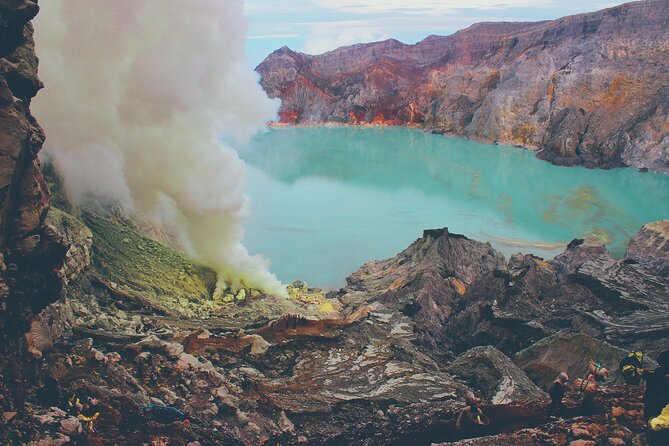
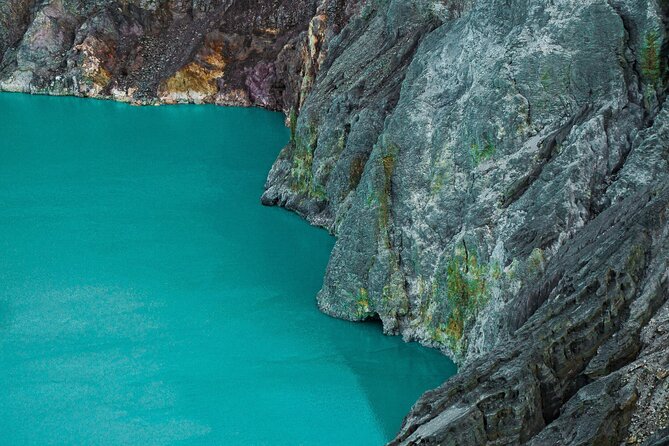
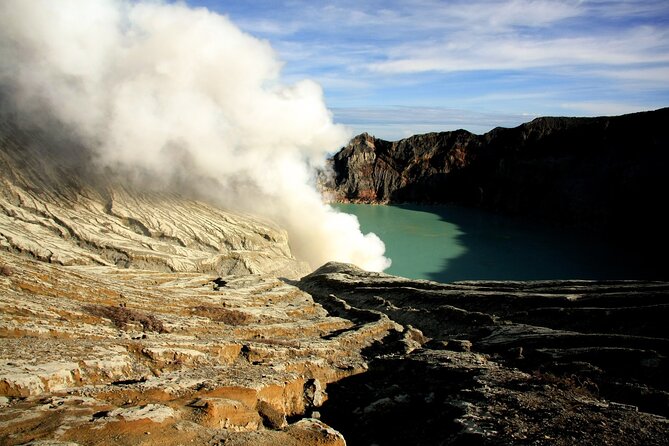
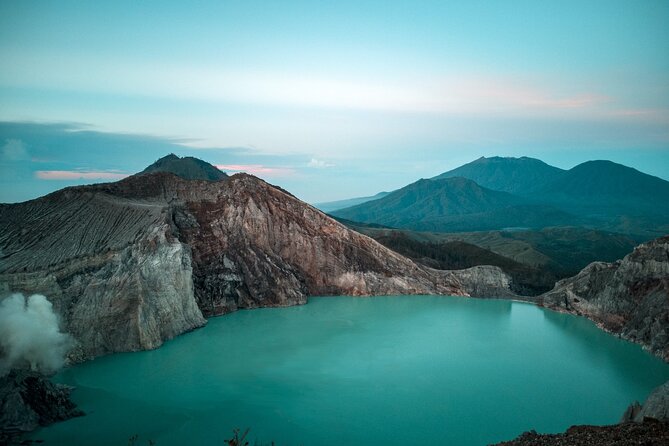
The reward continues after sunrise. From the crater viewpoint, you get a closer look at Ijen’s large acid lake and the volcanic interior of the mountain. The early light gives you a second reason to make the climb, even if clouds or conditions prevent a good view of the flames.
Ijen also gives you a direct look at hard physical work. Sulphur miners carry yellow blocks weighing about 60 to 80 kilograms in baskets hung from bamboo poles across their shoulders. They work with iron rods and little protective equipment, a sobering contrast to the organized trek offered to you.
A few more Kuta trips to weigh up
- Mount Batur Sunrise Trekking Private Tour with Breakfast and Hotel Transfer
★ 5.0 · 885 reviews - Private Tour Mount Batur Sunrise Trekking and Natural Hot Spring
★ 5.0 · 431 reviews - Mount Batur Sunrise Trekking Open Trip All-Inclusive
★ 4.5 · 63 reviews
Leaving South Bali at about 5:00 pm
The trip begins with pickup from selected hotels in Kuta, Legian, Seminyak, Jimbaran, or Nusa Dua. Your exact pickup time is confirmed after booking, but the stated start time is 5:00 pm. That broad pickup area makes the tour useful if you are staying in one of Bali’s main southern hotel zones.
Your Bali driver acts as a combined driver and tour escort during the road portion to Banyuwangi. The drive goes to Gilimanuk Harbor in western Bali, where you board the ferry for the short sea crossing to East Java.
The transport is practical rather than luxurious. You spend much of the first part of the experience in a vehicle, then wait for the ferry and continue by road after reaching Java. One useful point from the available feedback is that the driver service was courteous, while the guiding itself was described as more average. I would set expectations accordingly: the strongest part of the outing is the mountain and the local trekking support, not a polished, nonstop commentary program.
A small inconvenience can also occur before departure for the trek. One account describes waiting in a building until the rest of the group arrived so everyone could leave together. That is sensible for safety and transport, but it can feel frustrating after a long ride. Bring patience, water, and a small snack for the transfer.
Crossing to East Java after dark
The ferry crossing from Gilimanuk to East Java is part of the route, not an optional add-on. You arrive in East Java around midnight and are then driven directly to the trekking start point. This is why the experience lasts about 23 hours from pickup to hotel return.
The timing is demanding. You may be awake through the road transfer, ferry crossing, late-night arrival, trek, crater visit, return ferry, lunch, and afternoon drop-off. I would avoid placing another major activity immediately after this tour. You need the following day for rest.
The advantage of the overnight schedule is that you reach the mountain at the right time for the blue fire. The disadvantage is that there is no real night of sleep built into the itinerary. If you struggle with sleepless travel or long vehicle rides, the schedule may be the deciding factor.
Dinner is not included, so eat before pickup or carry something suitable for the journey. Drinks are also not included. A bottle of water is a sensible addition, along with a small personal snack that will not be awkward to carry on the trail.
The 3 km climb to Ijen Crater
At the trailhead, you receive a safety briefing and equipment that includes a flashlight and gas mask. The route to the summit is approximately 3 km, or about one mile, and takes roughly one to two hours. The surface includes uphill sections and flatter stretches, but this remains a serious mountain walk.
The darkness changes the feel of the climb. Your flashlight shows only the ground immediately ahead, and your pace is likely to be slower than on a daytime path. The guide’s job is especially useful here, since the group must move together and reach the crater area before dawn.
You should wear sports or hiking shoes with a firm sole. Long pants protect your legs, while a sweater or jumper, jacket, gloves, and hat help with the cold at altitude. The operator recommends exercising or doing physical activity the day before, which is a clear sign that this is not suitable for someone arriving with no walking fitness.
Take the health warnings seriously. The tour is not recommended for people with heart complaints, asthma, or other serious medical conditions. It is also not suitable for children aged 15 and under or for older people who may struggle with the climb. A doctor’s health certificate, valid for no more than three days before the tour, is required under the stated Ijen rules. If you do not have one, the operator may take you to a nearby doctor.
Same island, a completely different day out:
- Nusa Penida day trip: boat, 4 snorkeling, Manta rays & Land tour
★ 5.0 · 2,033 reviews - Bali Nusa Penida West Private All-Inclusive Tour
★ 5.0 · 1,277 reviews - Individual Bali Day Trip with Private Driver and Free WiFi
★ 5.0 · 755 reviews - Waterbom Bali Tickets – Single Day Pass
★ 4.5 · 620 reviews
Meeting sulphur miners on the mountain
The miners are not a staged attraction. They are working on the mountain, using traditional methods to break sulphur with iron rods and carry it out. Their loads can weigh 60 to 80 kilograms, carried in baskets balanced from bamboo poles over the shoulders.
This is one of the most meaningful parts of the outing, but it also calls for respect. You are seeing a dangerous livelihood, not a performance arranged for photographs. Follow your guide’s instructions, keep clear of working areas, and avoid treating the miners as props.
The included gas mask matters here. Sulphur fumes can make conditions difficult, particularly near the crater. The tour provides equipment, but you should still bring any personal medicine you need and pay attention to the safety briefing. The operator’s rules also prohibit throwing rubbish or seeds, dropping cigarette ends, or making fires.
Seeing the blue fire before sunrise
If weather and conditions cooperate, the guide leads you toward a view of Ijen’s blue fire in the darkness. This is the most unusual part of the tour and the reason for accepting the overnight schedule.
Do not expect a broad, brightly lit display. The flames are a natural phenomenon seen under difficult conditions, and weather can affect visibility. You may be dealing with darkness, fumes, uneven ground, and a crowd moving carefully through a confined area. Your guide will direct you on where you can go and how close you may approach.
The rules limit access to a maximum of 500 meters from the crater area. That restriction is there for safety and environmental protection, and you should not push beyond the permitted zone for a better photograph.
A camera can capture the color, but bring realistic expectations. The experience is better understood as a short, unusual glimpse during a demanding expedition than as a guaranteed photographic session. Keep your hands free as much as possible, protect your phone or camera, and do not let the search for a picture distract from the fumes and footing.
Breakfast above the crater, then daylight views
After the early crater visit, you stop for a light breakfast on the mountaintop. This is a welcome pause after the climb, but it is not a full meal. Since dinner is excluded and the night is long, eat properly before departure and carry an extra snack.
The guide then takes you back down for a closer look and photographs of Ijen Crater. In daylight, the scale of the crater becomes easier to understand. The acid lake is the visual counterpoint to the blue fire: the flames are a dark, fleeting event, while the lake and crater walls provide the broad view that stays with you afterward.
The descent can be as demanding as the climb. One account specifically described both the ascent and descent into the crater as challenging, with difficult conditions but spectacular scenery. Do not assume that walking downhill will be easy, especially after being awake all night.
The route and access rules can change with conditions. The information provided states that Ijen is closed on the first Friday of every month for cleaning, so avoid that date when planning. Good weather is also required, and a cancellation caused by poor weather can lead to a new date or a full refund.
Lunch, the return ferry, and the long way home
After the trek, you are transferred to Banyuwangi Harbor for the late-morning ferry back to Bali. Lunch at a local restaurant follows, with Balinese food included. Drinks are not included, so budget for those separately.
The meal comes at the right point in the day. By then, you have completed the climb, crater visit, and descent, and you are likely ready for something more substantial than the light breakfast. The final hotel drop-off takes place in the afternoon.
This return schedule is useful because the tour handles the ferry, road transfers, food, and hotel transport as one package. You do not need to arrange separate connections across Bali and East Java. The trade-off is that the entire day becomes a single long chain of travel and exertion.
At $153.85 per person, I see reasonable value if you are staying in the listed South Bali areas and want a managed trip to Ijen. Ferry crossings, two days of road transport, two guides, trekking equipment, hotel pickup and return, breakfast, lunch, and taxes are included. You are also paying for the logistics of reaching a remote mountain at the correct hour.
The price is less attractive if you want a relaxed Bali day trip or a private, highly polished tour. The group can include up to 10 people, and the guiding style may feel functional rather than deeply interpretive. Still, arranging this route independently would require coordinating transport, ferry timing, a Java transfer, a mountain guide, and the return journey while exhausted.
Who should book this Ijen tour
I would recommend this experience to a fit adult who wants a demanding natural outing and accepts that the blue fire is weather dependent. It suits you if you value the full route, including the ferry, sulphur miners, crater views, and local guide support, rather than only chasing a photograph.
It is a poor fit if you have asthma, heart problems, another serious medical condition, or limited stamina. The minimum age is 16, and the operator says the trip is not suitable for children or older people. The requirement for a recent medical certificate should not be treated as paperwork to ignore.
You should also be comfortable with a long night and little sleep. Pickup begins around 5:00 pm, East Java is reached around midnight, the trek begins in the early hours, and you return to your South Bali hotel in the afternoon.
The small group is a practical advantage. A maximum of 10 people is modest enough for the guide to offer individual attention, though you may still wait briefly for the full group before setting off. The staff are described as friendly and attentive to safety, which matters more here than entertaining narration.
Should you book the Mount Ijen Crater Trekking Tour?
Book it if the blue fire and sulphur mining are high on your Indonesia wish list, and if you are ready for a tough overnight route. The tour offers strong practical value because it joins Bali pickup, ferry travel, Java transport, trekking guides, safety gear, food, and hotel return in one booking.
Skip it if you want comfort, sleep, easy walking, or a guaranteed view. Ijen is extreme by ordinary holiday standards. For the right person, the hard climb makes the crater feel earned. For the wrong person, the 23-hour schedule can turn a remarkable mountain into a very long day.
FAQ
What time does the Mount Ijen tour start?
The stated start time is 5:00 pm. You receive your exact pickup time after reconfirmation.
Which Bali areas have hotel pickup?
Pickup and drop-off are offered from selected hotels in Kuta, Legian, Seminyak, Jimbaran, and Nusa Dua.
How long is the Mount Ijen trek?
The route to the summit is approximately 3 km, or about one mile, and normally takes around one to two hours.
Is the blue fire guaranteed?
No. You may see the blue fire before dawn, but it depends on weather and conditions.
What equipment is provided?
You receive a safety briefing, flashlight, and gas mask for the guided trek.
Is food included?
A light breakfast and lunch at a local restaurant are included. Dinner and drinks are not included.
Who should not take this tour?
The experience is not recommended for people with heart complaints, asthma, or other serious medical conditions. It is also not recommended for children aged 15 and under or for older people, and participants need a strong level of physical fitness.
Just added around Kuta
- Your Fragrance Selection: Bali Perfume Workshop and Creations★ 5.0 · 3 reviews
- Nusa Penida 4 Spot Snorkeling with Manta and Island Tour★ 4.5 · 11 reviews
- Premium White Water Rafting and Jungle Buggies in Bali★ 4.0 · 15 reviews
- Ubud Highlights Rice Terraces, Temple, Waterfall & Monkeys forest★ 5.0 · 23 reviews
- Experience West Nusa Penida Private Tour★ 4.5 · 14 reviews
- Indonesia: Waterbom Bali Entry Ticket★ 4.5 · 6 reviews
- West Nusa Penida Day Trip★ 5.0 · 8 reviews
- Waterbom Bali Tickets – Single Day Pass★ 5.0 · 5 reviews
Hiking & Trekking, compared.

Mount Batur Sunrise Hike and Natural Hot Spring Option
Read our review →
Mount Batur Sunrise Trekking Private All Inclusive
Read our review →
Mount Batur Sunrise Trekking (Private Tour and Breakfast at Restaurant)
Read our review →
Private Tour Mount Batur Sunrise Trekking and Natural Hot Spring
Read our review →
Private Tour : Mount Batur Sunrise Trekking With Private Guide
Read our review →
3-Day Ethical Orangutan Jungle Trek | Bukit Lawang, Sumatra
Read our review →Browse the lists this tour appears in