
Reviewed · 2-DAY EXPERIENCES
Mount Rinjani 2 Days and 1 Night to Senaru Crater Rim
Mount Rinjani’s Senaru Crater Rim gives you the mountain’s grandest views without forcing you to climb to the summit. In two days, you walk from 600 meters through tropical forest to a 2,641-meter campsite overlooking Segara Anak Lake, Baru Jari volcano, Lombok, Bali, and the three Gilis.
I like the clever route choice and the strong support system. You get guides, porters, tents, sleeping gear, meals, drinking water, trekking poles, rain protection, and transfers from Senaru to the trailhead. Guides including Ibrahim, Rizal, and Sapar have been praised for kindness and steady help. The drawback is simple: this is still a hard uphill walk, and the descent can leave you sore for several days.
In This Review
- Key points to know before you book
- Why the Senaru rim is the smart Rinjani choice
- Day one, from Senaru village to 2,641 meters
- Night at the crater edge
- Sunrise over Segara Anak and Mount Sangkareang
- What the $152 price covers
- Fitness, food, and safety considerations
- Who will enjoy this two-day trek
- Booking advice and final verdict
- FAQ
- Where does the Mount Rinjani trek start?
- What time does the trek begin?
- How long is the experience?
- How high does the route go?
- Does this trek climb to Mount Rinjani’s summit?
- Is camping equipment included?
- Are meals and drinking water included?
- Is the activity private?
- Is the entrance fee included?
Key points to know before you book
- The destination is the crater rim, not the summit: You get remarkable views of the lake and volcanic cone without tackling Rinjani’s most demanding summit route.
- The climb gains about 2,041 meters: The trail rises from roughly 600 meters in Senaru to 2,641 meters at camp.
- The forest route brings shade but not an easy walk: Dense tropical woodland covers much of the first day, with a long, steady ascent.
- Camping equipment is supplied: A double-size tent, mattress, pillow, sleeping bags, camp chairs, and a toilet tent are included.
- The best moments come at sunrise and sunset: Look for sunrise between Rinjani and Mount Sangkareang, plus sunset toward Bali.
- The support is a major part of the value: Porters carry camping gear, while your guide manages the pace, route, and camp routine.
Why the Senaru rim is the smart Rinjani choice
Rinjani is a serious volcano trek, but you do not need to chase its summit to get a memorable mountain experience. This trip aims for the Senaru Crater Rim, where the reward is a broad view into the crater and across Lombok.
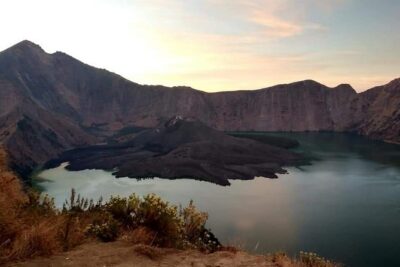
From camp, you can look down toward Segara Anak, Rinjani’s crater lake, and see the volcanic cone of Baru Jari. On a clear day, the view reaches across much of Lombok and out toward the three Gili islands. You may also see Bali in the distance, especially around sunset.
I like this option for people who want a proper mountain adventure but do not want the summit push. The two-day schedule keeps the trip focused. You walk up, sleep at altitude, watch the morning light, and return to Senaru the same day.
That does not make it gentle. The route begins at about 600 meters and reaches 2,641 meters. You gain a great deal of height in a short time. The tour describes the physical demand as moderate, but you should treat that as a baseline, not a promise of an easy outing.
A few more Lombok trips to weigh up
- Rinjani Trekking Three Days Two Night Summit Lake
★ 4.5 · 73 reviews - 4-in-1 • Gili Islands Snorkel & Sunset Half-day Catamaran Cruise
★ 5.0 · 68 reviews - Trekking Mt. Rinjani 2 Days 1 Night Senaru Crater Rim
★ 5.0 · 55 reviews
Day one, from Senaru village to 2,641 meters
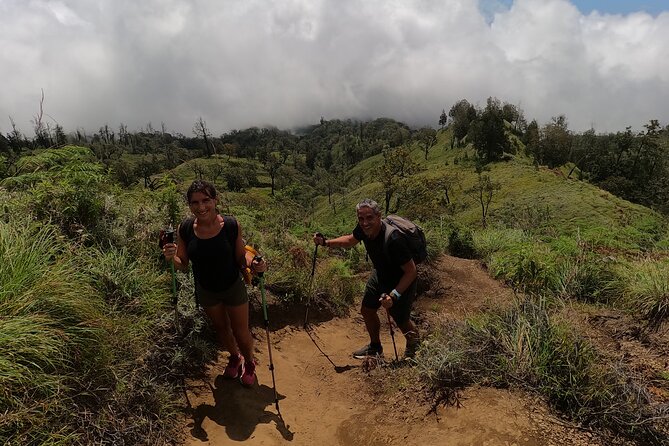
Your morning begins with breakfast, followed by a transfer from Senaru to the Rinjani National Park entrance. Registration and a briefing take place before you start walking, usually around 7:00 to 7:30 in the morning.
The first section runs through dense tropical forest. This is one of the route’s practical advantages. Trees provide shade, and the forest gives the climb a slower, more natural start than a bare volcanic slope.
You may notice a wide range of plant life and hear birds along the way. If you are lucky on the return walk, you might see a rare black monkey. Wildlife sightings are not guaranteed, so treat them as a bonus rather than part of the core itinerary.
The route continues uphill for about seven hours. That figure matters. You are not taking a short walk to a viewpoint. You are spending most of the day on your feet, with a sustained climb toward the crater edge.
Your guide sets the pace and helps you manage the route. Previous groups have had guides named Ibrahim, Rizal, Sapar, and Ir, though the person assigned to your trip may be different. Ibrahim received particular praise for helping a struggling hiker while keeping the mood light, and Rizal was noted for attentive guiding and good care.
Porters carry the camping equipment, which lets you walk with a smaller personal bag. That is a major help on a climb of this length. You still need to carry your own day-to-day items, including clothing, water for immediate use, snacks if desired, and personal essentials.
Lunch is included, and the supplied meals have been well received for both taste and quantity. The package also lists a second lunch and breakfast service, so confirm the exact meal timing with the operator before departure. Food needs deserve attention here, since one account raised concerns about diet handling and first-aid support.
As you climb above the forest, views begin to open. The exact sight lines depend on weather and cloud, but the change from enclosed woodland to high crater terrain is part of the day’s drama.
The camp sits at the Senaru Crater Rim. The elevation gives you a wide view, but it also brings colder, windier conditions than in the village. The supplied equipment includes a double-size tent, sleeping bags, pillows, mattresses, camp chairs, and a toilet tent.
Dinner is prepared for you at camp. After eating, you can settle in and wait for the evening light. Sunset toward Bali is one of the trip’s special features, though clear weather is needed for the full effect.
Night at the crater edge
Camping at 2,641 meters is basic, but the package covers the items that matter most. You get shelter, sleeping gear, a mattress, and a designated toilet tent rather than needing to bring a full camping kit.
The double-size tent suits couples and people traveling together. It also explains why this trip works well for honeymooners who want an active shared experience, though the cold and uphill effort may not suit every couple.
Do not expect hotel comfort. The point is the setting, not luxury. You are sleeping beside one of Indonesia’s great volcano views, with the crater and lake below and open sky overhead.
Bring the warmest practical layers you own. The operator lists a warm jacket and wind jacket as items you should bring, along with long pants and gloves. Rain protection is included, but personal clothing still matters. A mountain night can feel very different from Lombok’s warm coastal weather.
The guide and porters also help make camp workable. Camp chairs are supplied, and the porters carry the bulky equipment. That support is one of the clearest reasons the $152 price can make sense.
Sunrise over Segara Anak and Mount Sangkareang
Day two begins with breakfast and sunrise. The view is aimed between Mount Rinjani and Mount Sangkareang, with the crater lake and Baru Jari volcano below.
This is the moment that justifies the climb for many people. You do not need to reach the summit to see the mountain at its most powerful. From the rim, the crater gives you scale: lake, volcanic cone, steep walls, and distant island views all appear in one frame.
Sunrise timing depends on weather and the day’s conditions, but the schedule is built around seeing it before descending. Bring a warm layer close at hand so you do not have to search through a packed bag in the cold.
After breakfast, you begin the descent through the rainforest to Senaru Village. The return takes about six hours, so do not think of day two as an easy walk after the main event.
Downhill walking uses your legs differently from the climb. Loose or uneven ground can also make the descent tiring. Trekking poles and sticks are included, and you should use them if they help protect your knees and improve balance.
The forest becomes more familiar on the way down, and this is your best chance of spotting a black monkey if conditions allow. The long descent also gives you time to appreciate the plant life and bird habitat you may have passed too quickly the previous day.
The tour ends back at the Senaru meeting point. Transfers from Senaru to the trek starting point are included, and previous arrangements have also included help with transport to and from Senaru. Confirm the precise pickup and drop-off plan before you set out, especially if you are arriving from another part of Lombok.
Same island, a completely different day out:
- Learn to cook Indonesian food at Gili Cooking Classes Trawangan
★ 5.0 · 352 reviews - Tetebatu Walking Tour – Rice Terraces, Waterfall & Monkey Forest
★ 5.0 · 349 reviews - Gili Island Snorkeling Trip – Gili Trawangan, Gili Meno, & Gili Air, From Lombok
★ 5.0 · 330 reviews - Snorkeling with turtle and statue in Gilis
★ 4.5 · 301 reviews
What the $152 price covers
At $152 per person, this is not simply a guided walk. The price includes several services that would be awkward to arrange separately:
- Trekking guide
- Porters for camping equipment
- Dinner, lunch, and breakfast services as listed
- Safe drinking water
- Double-size tent
- Sleeping bags, pillows, and mattresses
- Camp chairs and a toilet tent
- Trekking poles and sticks
- Raincoat
- Transfer from Senaru to the trailhead
- Insurance
That package gives the trip good practical value, especially for first-time volcano trekkers. You do not need to buy or transport a tent, sleeping system, or cooking setup. The porters also reduce the weight on your back.
The entrance fee to Mount Rinjani is not included. The operator also lists trekking shoes, long pants, gloves, a small bag or day pack, and warm and wind jackets as your responsibility.
The price should be judged against the physical work involved, not against a sightseeing bus tour. You are paying for a guide, porters, food, camping equipment, and coordination in a national park setting. Group discounts are available, which may improve the value for families or private groups.
This is a private activity, so only your group takes part. That gives you more control than a large mixed group, although the exact flexibility of the walking pace should be discussed with the operator.
Fitness, food, and safety considerations
The activity requires a moderate level of physical fitness. In practical terms, you need to handle about seven hours of uphill walking on day one and about six hours of downhill walking on day two.
You do not need to be a competitive mountaineer, but regular walking or hiking preparation will help. A short city stroll is not enough training for a climb from 600 to 2,641 meters.
Families have taken part, including a group with children aged six and eight. That shows the route can work for some active families, but children’s stamina and mountain experience vary widely. Parents should make the decision based on the child’s ability to manage long hours outdoors, not only on the fact that families are accepted.
The strongest praise goes to the guides and porters. Their work is not decorative. They carry equipment, help with camp, prepare or transport meals, and support you when the climb becomes difficult.
Still, you should ask direct questions about dietary needs and first-aid arrangements before booking. One experience raised concerns about diet handling and medical support. The available information confirms insurance is included, but it does not give detailed medical procedures or emergency transport terms.
Wear proper trekking shoes, long pants, and gloves. Bring a small day pack, a warm jacket, and a wind jacket. The tour supplies rain protection, but you should still protect personal items from wet weather.
Who will enjoy this two-day trek
I would recommend this experience to you if you want:
- A major Rinjani view without climbing the summit
- A private trip for your own group
- A supported trek with porters and supplied camping gear
- A family or honeymoon adventure built around scenery
- One night outdoors rather than several nights on the mountain
- A guided route through tropical forest and crater terrain
I would be cautious if you dislike steep climbs, long walking days, cold nights, or basic camping. The scenery is impressive, but you must earn it.
The 2-day, 1-night plan works well when your time in Lombok is limited. It gives you the crater rim, sunset, sunrise, and a full return to Senaru without adding a summit attempt.
Booking advice and final verdict
This tour earns a strong recommendation rate of 98 percent and a 4.9 rating from 42 reviews, with the most consistent praise directed at the guides, porters, organization, food, and views. The few cautions are important: the walk is hard, medical support details are limited, and one booking dispute involved unclear communication around a temporary crater closure.
You should confirm park access, weather conditions, meal arrangements, dietary needs, pickup details, and the entrance fee before departure. The activity is non-refundable and cannot be changed after booking, so do not reserve it until your dates and fitness plans are firm.
I would book this if you want the best Rinjani scenery in a short format and accept a demanding hike. I would skip it if you are looking for a soft adventure. The Senaru Crater Rim is easier than a summit climb, but it is still a real mountain trek.
FAQ
Where does the Mount Rinjani trek start?
The meeting point is in Senaru, Bayan, in North Lombok Regency, West Nusa Tenggara, Indonesia. The group is transferred from Senaru to the trek starting point.
What time does the trek begin?
The activity starts at 7:00 am. The walking portion is scheduled to begin around 7:00 to 7:30 am after breakfast, registration, and a briefing.
How long is the experience?
The trek takes approximately two days and one night. Day one lasts about seven hours, and day two takes about six hours.
How high does the route go?
The route starts at about 600 meters and reaches the Senaru Crater Rim at 2,641 meters.
Does this trek climb to Mount Rinjani’s summit?
No. The destination is the Senaru Crater Rim. You see the summit area, crater lake, and Baru Jari Mountain from the rim.
Is camping equipment included?
Yes. The package includes a double-size tent, camp chairs, a toilet tent, sleeping bags, pillows, and mattresses.
Are meals and drinking water included?
Yes. Dinner, lunch, breakfast, and safe drinking water are included. The package lists two lunches and two breakfasts, so confirm the exact meal schedule with the operator.
Is the activity private?
Yes. Only your group participates in the activity.
Is the entrance fee included?
No. The Mount Rinjani entrance fee is not included in the tour price.
Just added around Lombok
- Trekking Rinjani Volcano To Crater Rim Senaru 2D-1N Private – Syam Trekker★ 5.0 · 45 reviews
- Waterfall Tour And Sasak Traditional Tour★ 5.0 · 3 reviews
- Full-Day Private Trip to South Lombok★ 5.0 · 15 reviews
- Trekking Rinjani Mountain Summit 2 Days 1 Night – Em Adventure★ 5.0 · 42 reviews
- MODERATE HIKING: 2D/1N Crater Rim Senaru | Rinjani Samalas Tour★ 5.0 · 8 reviews
- Panorama Walking Tour and Culture, West Lombok★ 5.0 · 6 reviews
- Fantastic trip to Sindang Gile & Tiu Kelep Waterfall★ 4.5 · 3 reviews
- Trekking Rinjani 1 Day Trek Senaru Crater Rim★ 5.0 · 3 reviews
2-Day Experiences, compared.
2 Days Discover Scuba Diving in Nusa Lembongan – Scuba Initiation
Read our review →
From Surabaya / Malang : Mt Bromo Sunrise – Ijen Blue Fire 2D1N
Read our review →
2Days – Bromo Sunrise Ijen Adventure via Malang
Read our review →
ORANGUTAN TREK (2D/1N) by EcoTravel Bukit Lawang
Read our review →
Monkey Business 2 days – 1 night Jungle Trekking (including rafting)
Read our review →Browse the lists this tour appears in