
Reviewed · BALINESE COOKING CLASSES
Balinese Authentic Cooking Class in Ubud
The best part of this Ubud cooking class is that the food comes with context. You do not simply chop vegetables in a classroom. You visit a local market, see a Balinese family compound, walk through a farm, and then use fresh spices in a meal you cook yourself. The market visit and farm harvest make the cooking feel tied to daily life, not staged for tourists.
I like the generous, hands-on format, where you may prepare as many as six dishes and use a traditional lesung, or mortar and pestle, to pound spices. I also like the friendly teaching style reported from hosts including Ron and Putri, who explain techniques patiently and keep the mood relaxed. The main consideration is timing: the market visit is offered only with the morning class, and one session may feel a little rushed when the chef adds ingredients or moves between dishes.
In This Review
- Key details before you book
- Why this cooking class feels different from a standard lesson
- Start with the Ubud pickup and a local welcome
- The morning market adds something the later classes miss
- A traditional Balinese house puts the recipes in context
- Harvest spices in the farm garden
- Learn the traditional technique, not just the recipe
- Choose regular, vegetarian, or vegan food
- The meal is the payoff
- Is $39.71 a fair price?
- Who will enjoy this class most?
- Booking and cancellation advice
- Should you book Lesung Bali?
- FAQ
- How long does the Balinese cooking class last?
- Where does the cooking class take place?
- Is hotel pickup included?
- Is transportation outside Ubud included?
- Does every class visit a traditional market?
- What menu choices are available?
- How many people can join the activity?
- What is included in the price?
- Can I cancel for a full refund?
- What happens if bad weather cancels the class?
Key details before you book
- Morning, afternoon, or evening choices: Only the morning class includes the traditional market visit.
- A full meal, not just a demonstration: You cook several dishes and eat what you prepare, often with dessert.
- Three menu styles: Regular, vegetarian, and vegan options are available.
- Small-group setting: The class accepts a maximum of 15 people, with some sessions much smaller.
- Ubud transfers included: Pickup and drop-off are provided within the Ubud area.
- Budget-friendly cultural outing: At $39.71 per person, the price covers transport in Ubud, food, drinks, instruction, fees, and taxes.
Why this cooking class feels different from a standard lesson
Many cooking classes begin when you sit at a workbench with a bowl of ingredients. This one begins earlier, with an introduction to the places and people connected to Balinese food.
The experience takes place on the west side of Ubud, in a countryside setting surrounded by green areas. That location matters. You get away from the busiest central streets and spend the cooking portion in a more relaxed outdoor setting, though the exact feel depends on the weather and group size.
The class lasts about five hours. That gives enough time for more than a quick recipe lesson. You can learn about local ingredients, see a traditional home, gather some spices, cook several dishes, and sit down for a proper meal.
The strongest reason to book is the combination of food and everyday Balinese culture. You are not just learning how to make a sauce. You are also hearing about family compounds, household design, local customs, and the way ingredients move from market or garden to kitchen.
More Balinese Cooking Classes in Ubud
- Ubud Cooking Class Bali with Balinese Chef
★ 5.0 · 1,609 reviews - PRIVATE Authentic Balinese Cooking Class in Ubud at Putu’s Home
★ 5.0 · 644 reviews - Balinese Farm Cooking Class by Pemulan Bali
★ 5.0 · 410 reviews
Start with the Ubud pickup and a local welcome
Pickup is included within the Ubud area, and several sessions have begun with prompt hotel collection and clear communication. The vehicle is air-conditioned, and mineral water is included. If you are staying outside Ubud, check the extra charge before booking rather than assuming the included transfer covers your hotel.
On arrival, you can expect coffee or tea and a Balinese cake or local snack. This small pause helps set the pace. The class is not designed as a rushed production line, and the time for conversation is part of the experience.
Depending on the host, you may meet Ron, Putri, Don, Gustie, or Begul. The teaching style can vary slightly from one chef to another, but the repeated pattern is warm instruction, humor, and plenty of chances to ask questions. Putri is especially noted for patient explanations, while Ron is described as funny and engaging. Don has also used the cultural part of the visit to explain Balinese family life, ceremonies, and traditions.
Because the group limit is 15, the word small-group should be read with some flexibility. A group of four will feel much more personal than a full group. One morning session had just a single participant, creating a private market tour and cooking lesson. You cannot count on that, but the format allows for a more intimate class when numbers are low.
The morning market adds something the later classes miss
Choose the morning option if the market matters to you. It includes a visit to a traditional local market, where you can see the produce, fruits, vegetables, and spices used in Balinese cooking. You may also sample local fruit and learn why the morning market matters in local life.
The market is not just a shopping stop. It gives you a better sense of how Balinese cooks work with fresh ingredients and strong seasoning. You can look at the spices before they are ground into a paste, which makes the later cooking steps easier to understand.
The trade-off is an early start. If you prefer slow mornings or are recovering from a late arrival in Bali, the afternoon or evening class may be more comfortable. Those options still include the traditional house, farm, and cooking lesson, but they do not include the market tour.
The market can also be active and informal, so do not expect a polished museum visit. That is part of its value. You are seeing ingredients in a working local setting rather than a display made for a class.
A traditional Balinese house puts the recipes in context
After the market, the class visits a local Balinese home. The visit offers a look at a family compound, the arrangement of its buildings, the garden, and aspects of household life.
This stop is one of the best reasons to choose this class over a cooking lesson held entirely at a restaurant. Balinese homes can reflect family structure, community customs, and practical daily routines. Seeing the grounds gives you a clearer sense of the setting in which many traditional dishes are prepared and shared.
The visit may include coffee, tea, snacks, fruit, and conversation. Some sessions have included time with the host family, while others focused more on the grounds and compound. One account noted that the inside of the home was not visited, so you should think of this as an introduction to a Balinese home and its layout, not a full house tour.
The pace is usually relaxed, which I consider a plus. You have room to ask questions instead of racing from one photo stop to the next. If you are mainly interested in cooking and less interested in culture, this portion may feel longer than necessary. For most people, though, it gives the meal a useful sense of place.
Same island, a completely different day out:
- All-Inclusive Ubud Private Tour
★ 5.0 · 14,344 reviews - Best of Ubud Full-Day Tour with Jungle Swing
★ 5.0 · 8,571 reviews - Ubud: Monkey Forest, Jungle Swing, Rice Terrace, and Water Temple
★ 5.0 · 7,160 reviews - Best of Ubud 1-Day Private Tour
★ 5.0 · 4,451 reviews
Harvest spices in the farm garden
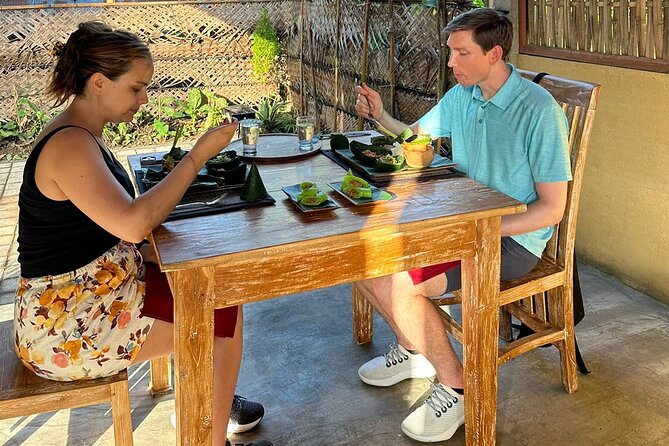
The next stop is the farm, where you help explore the garden and harvest spices for the recipes. The menu is decided before this part begins, so the ingredients you collect connect directly to what you will cook.
That connection is simple but effective. When you later pound spices with a lesung, you know where some of them came from and why they matter. You also get a closer look at the fresh ingredients that shape Balinese flavor.
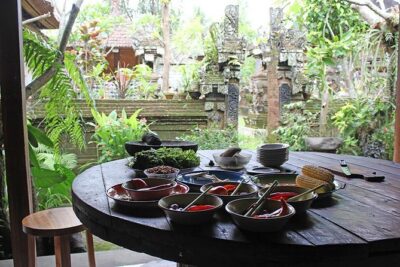
The garden setting is one of the class’s pleasant details. The cooking area is separate, with the tools needed for the lesson, while the surrounding grounds provide a calm countryside setting. Some sessions have taken place in clean, attractive facilities set within the garden.
The outdoor setting has one practical weakness: the activity requires good weather. If poor weather forces a cancellation, you are offered another date or a full refund. Bring a willingness to adapt, since the farm portion is central to the experience.
Learn the traditional technique, not just the recipe
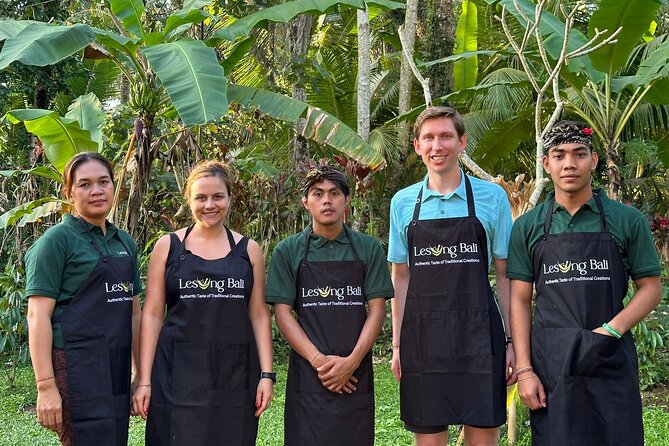
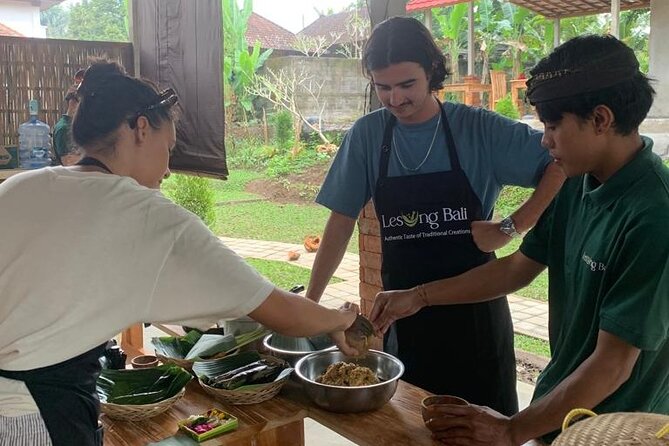
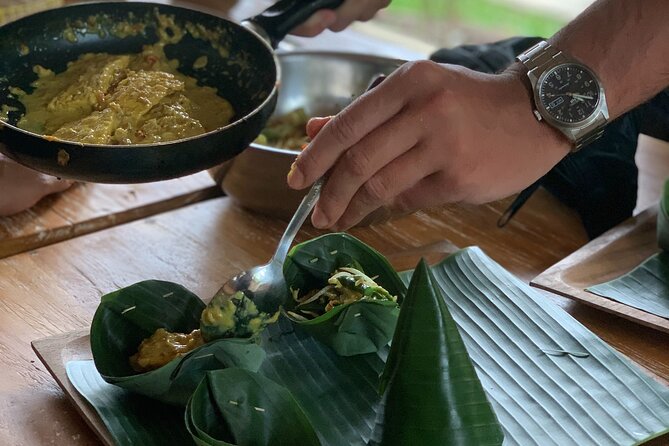
The cooking lesson is hands-on. You do not simply watch the chef prepare the food while you take notes. You chop, measure, grind, and cook with help from the chef and assistants.
The lesung is a highlight. Instead of relying only on a blender, you use a large mortar and pestle to pound spices in the traditional Balinese way. This teaches more than a mechanical step. You can see how a spice paste changes as the ingredients break down, and you get a feel for the texture that helps define many Balinese dishes.
The chef explains chopping methods, ingredient quantities, cooking steps, and the role of different spices. The class is suitable for people with little cooking experience. Several sessions have been described as easy to follow, with patient help available when needed.
Still, the class is not identical for every group. One participant felt the chef moved quickly at points and added small spices without explaining each one first. If you want to understand every ingredient, ask as soon as something is added. The chefs appear willing to answer questions, but you may need to speak up when several dishes are cooking at once.
Rice is another detail worth noting. In one session, the rice was prepared by the staff rather than by the participant. If you want to learn every part of the meal, ask whether you will prepare the rice yourself.
Choose regular, vegetarian, or vegan food
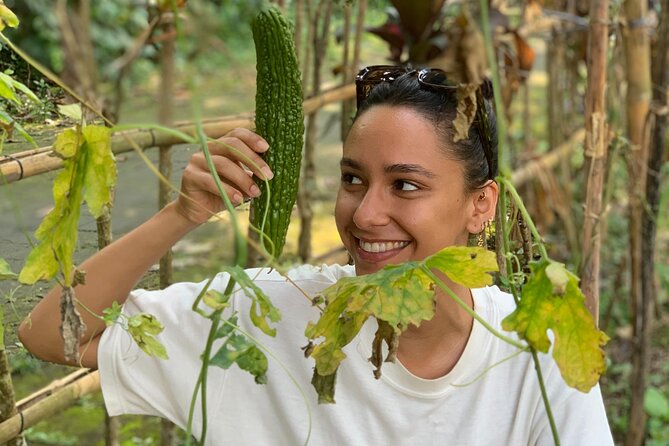
You can select a regular, vegetarian, or vegan menu during the class. This makes the experience practical for mixed groups, since one person can choose meat while another follows a plant-based menu.
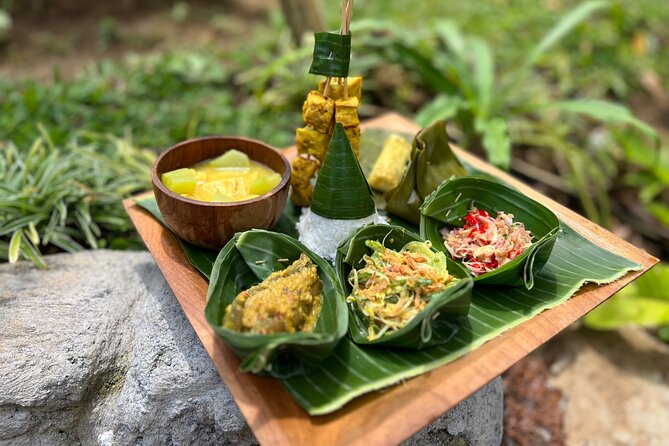
The exact dishes can vary by menu and session. The regular option has included six dishes plus dessert, and other classes have also prepared a six-course meal. Ingredients are fresh, and some come directly from the farm garden.
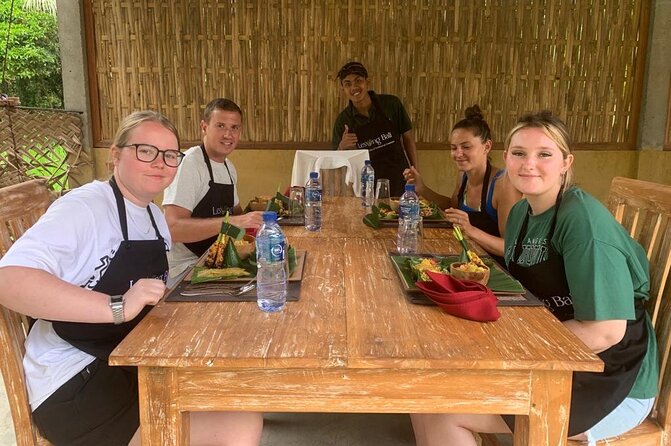
The quantity is generous. Plan to arrive hungry, because you will eat the finished dishes after cooking and may have more food than you can finish. Coffee, tea, mineral water, and a Balinese cake are included as well.
This is a good choice if you want recipes you can repeat at home. You learn a set of techniques rather than only watching a chef perform. Still, you should not expect a printed cookbook unless the provider specifically confirms one. The useful souvenir is the method: the spice paste, the balance of ingredients, and the confidence to try the dishes again.
The meal is the payoff
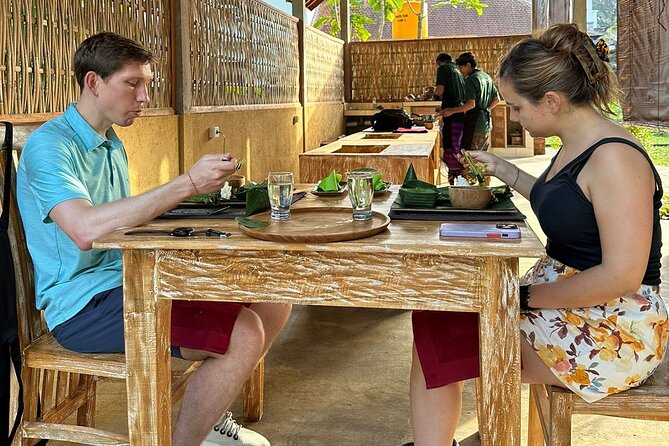
After roughly two hours of cooking, you sit down to eat. This is not a token tasting. You share a substantial meal made from the dishes prepared during the class.
The food benefits from the garden ingredients and the hands-on preparation. You notice the aromas as the spices are pounded and cooked, then taste the result while the process is still fresh in your mind.
The meal also gives you time to compare techniques and ask final questions. Beginners can see how much they accomplished, while experienced cooks can focus on spice combinations and traditional preparation.
The food is a strong point, but remember that the class is the main event. If you only want a Balinese meal, a restaurant will be simpler. Choose this experience when you want to understand how the meal is made and take part in the work.
Is $39.71 a fair price?
At $39.71 per person, this is good value for a roughly five-hour activity, especially if you stay in Ubud and use the included shuttle. The price covers the air-conditioned vehicle, mineral water, coffee or tea, Balinese cake, cooking ingredients, instruction, fees, and taxes.
The value comes from the number of parts packed into one outing. You receive local transport, a market visit with the morning option, a traditional-home visit, a farm tour, a cooking class, and a full meal. Paying separately for transport and a meal could easily reduce the apparent savings of a cheaper class with fewer inclusions.
Extra transportation applies outside Ubud. The listed car charges are IDR 450,000 from Kuta, Seminyak, Sanur, or Canggu, IDR 500,000 from Nusa Dua or Jimbaran, and IDR 550,000 from Uluwatu. Those costs make the class less attractive if you are staying far from Ubud, particularly for a solo participant.
Group discounts are available, but the discount amount is not specified. Ask for the final group price before booking.
Who will enjoy this class most?
I would choose this class for someone who wants more than a recipe card. It suits first-time cooks, couples, families, solo visitors, and anyone curious about Balinese homes and food traditions.
It is particularly good for solo visitors because the small-group format can make it easy to meet people, and a low-enrollment day may feel almost private. It also works well for a family, since the cooking is active and the food is shared afterward.
You should think twice if you dislike early starts, outdoor settings, group activities, or strong spice preparation. The morning class requires more time and energy because of the market visit. The afternoon and evening choices offer a shorter route into the cooking but leave out one of the most distinctive stops.
The class also requires good weather and a minimum number of participants. If the minimum is not reached, you are offered another date or experience, or a full refund.
Booking and cancellation advice
Confirmation is provided at booking. For the smoothest day, choose the morning option if you want the market, confirm that your hotel is inside the Ubud pickup area, and tell the provider your menu preference.
You can cancel for a full refund up to 24 hours before the start time. Cancellations or changes made within 24 hours are not refunded or accepted. The cut-off follows local Bali time, so keep that in mind when changing plans.
Should you book Lesung Bali?
Book it if you want a cultural outing that ends with a meal you helped make. The strongest parts are the market visit, traditional home, farm harvest, use of the lesung, and patient, humorous teaching from hosts such as Ron and Putri.
Choose the morning class for the fullest itinerary. Choose afternoon or evening if you care more about cooking than the market or need a gentler start. At $39.71, the experience offers solid value for anyone staying in Ubud and interested in local food, though the added car fee can change the calculation for visitors based elsewhere.
I would not book it solely for a restaurant-quality dinner. I would book it to learn how Balinese flavors are built, see how food connects with family life, and leave with techniques you can use at home.
FAQ
How long does the Balinese cooking class last?
The experience lasts approximately five hours.
Where does the cooking class take place?
The class is located on the west side of Ubud, in a countryside area surrounded by green space.
Is hotel pickup included?
Free shuttle service is included for pickup and drop-off within the Ubud area.
Is transportation outside Ubud included?
No. Extra transportation charges apply outside Ubud. The listed charges are IDR 450,000 from Kuta, Seminyak, Sanur, or Canggu, IDR 500,000 from Nusa Dua or Jimbaran, and IDR 550,000 from Uluwatu.
Does every class visit a traditional market?
No. The traditional market visit is offered with the morning class only.
What menu choices are available?
You can choose a regular, vegetarian, or vegan menu during the class.
How many people can join the activity?
The maximum group size is 15 people.
What is included in the price?
The price includes coffee or tea, an air-conditioned vehicle, mineral water, a Balinese cake, all fees and taxes, and free shuttle service within Ubud.
Can I cancel for a full refund?
Yes. You must cancel at least 24 hours before the experience start time for a full refund.
What happens if bad weather cancels the class?
You are offered a different date or a full refund if the experience is canceled because of poor weather.
More Workshops in Ubud
- Ubud Silver Class Jewelry making in bali
★ 5.0 · 978 reviews - Canggu Scooter Lessons
★ 5.0 · 195 reviews - Crafting Heritage Batik Painting Workshops
★ 5.0 · 164 reviews - Ubud Bali Silver Jewelry Class
★ 5.0 · 163 reviews
More Cooking Classes in Ubud
- Balinese Ubud cooking school (9 Dish Cooking and Market Tour)
★ 5.0 · 540 reviews - PRIVATE Balinese Cooking Class in Ubud with Dewa with Transfers
★ 5.0 · 213 reviews - Balinese Cooking class with traditional morning market visit
★ 5.0 · 161 reviews - Jambangan Bali Cooking Class
★ 5.0 · 142 reviews
Just added around Ubud
- Bali Airport Pick-up to Ubud (Arrival Transfer)★ 5.0 · 4 reviews
- Munduk Car Hire with English Speaking Driver★ 5.0 · 14 reviews
- Bali Airport – Arrival Transfer★ 5.0 · 5 reviews
- Bali Airport: One-Way Private Transfer To/From Hotel★ 5.0 · 25 reviews
- Bali ATV Quad Bike and White Water Rafting – All Inclusive★ 5.0 · 7 reviews
- Bali ATV Ride Ubud Jungle Track★ 4.5 · 5 reviews
- Bali All Inclusive : Tlaga Singha Infinity Pool & Atv Adventure★ 5.0 · 21 reviews
- Bali ATV Ride with Jungle Swing and Rice Terrace Tour★ 5.0 · 50 reviews
Balinese Cooking Classes, compared.
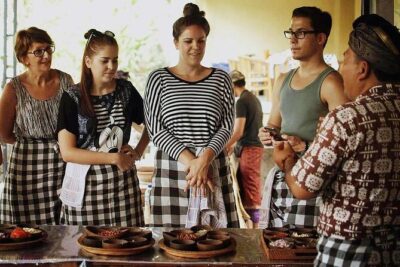
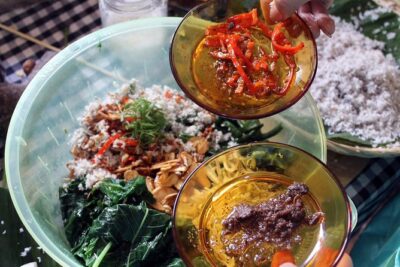
PRIVATE Authentic Balinese Cooking Class in Ubud at Putu’s Home
Read our review →
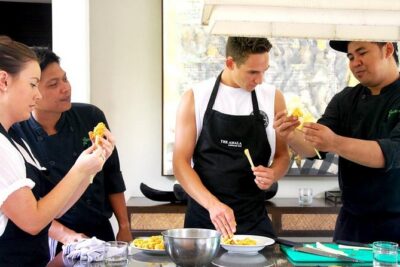
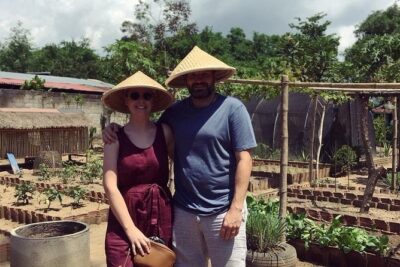
PRIVATE Balinese Cooking Class in Ubud with Dewa with Transfers
Read our review →
Balinese Cooking class with traditional morning market visit
Read our review →Browse the lists this tour appears in